Rare Disease Summer School 2026
(Tuesday, June 23rd to Friday, June 26th)
As every year, the ITINERARE Rare Disease Summer School was one of the highlights of our academic calendar. Once again held at the tranquil Kartause Ittingen in Thurgau, the event brought together young clinicians and researchers, experienced rare disease experts, and patient representatives for four inspiring days of learning, exchange, and collaboration.
Under the overarching theme Rare Diseases, this year’s Summer School welcomed a particularly diverse and international group of participants and speakers. The exchange across disciplines, institutions, and countries sparked lively discussions and highlighted once more that, despite differences in national healthcare systems, many of the key challenges in the rare disease field are shared globally. What unites everyone is a strong commitment to improving care and advancing research for people living with rare diseases.
Participants particularly valued the opportunity to gain a deeper understanding of the complexity of rare diseases, including their clinical, scientific, ethical, and financial dimensions. A key message that resonated throughout the programme was the importance of truly partnering with patients and their families—“Partner with families, not just inform them.” This perspective underscored the central role of patient involvement, alongside collaboration and the importance of data sharing initiatives such as rare disease registries in driving meaningful progress.
We were pleased to welcome Prof. Shamima Rahman as our keynote speaker, presenting on “Mitochondrial disease: a tale of two genomes.”
A particularly impactful contribution came from Hansruedi Silberschmidt, who shared his experience as a patient in “No coughing – living with a rare disease.” In addition, Dr. Alfred Wiesbauer offered a deeply personal perspective as a patient father, providing invaluable insights into the lived experience of rare diseases.
This year we also welcomed:
Prof. Nine Knoers (Department of Genetics, University Medical Center Groningen, the Netherlands): Latest developments in exome and genome sequencing: impact for rare diseases
Dr. Jasmin Barman-Aksözen (Scientific advisor, Swiss society for porphyria, Switzerland): Let the sunshine in! Development, approval and benefit assessment of afamelanotide, the first drug for treating erythropoietic protoporphyria.
Prof. Marshall Summar (Children‘s National Medical Center, George Washington University / CEO: Uncommon Cures, USA): Rare diseases today and Workshop: Designing rare disease clinical trials
Prof. Stephan Neuhauss (Department of Molecular Science, University of Zurich, Switzerland): Studying rare diseases in the (not so rare) Zebrafish model organism
Prof. Isaac Canals (University Children’s Hospital Zurich, Switzerland): iPSC and genome editing as tools to generate human in vitro models of neuronopathic lysosomal storage disorders
Dr. Fabienne Hartmann-Fritsch (University of Zurich, CUTISS AG, Switzerland): denovoSkin: Personalised skin to treat skin defects
Prof. Olivier Devuyst (Institute of Physiology, University of Zurich, Switzerland): Genetic architecture driving therapeutic targets in kidney diseases
Prof. Günter Schwarz (Department of Biochemistry, University of Cologne, Germany): From neurodegeneration in ultra rare sulfite oxidase deficiency to the treatment of kidney diseases
Kelly Ormond (Health Ethics and Policy Lab, D-Heath Sciences and Technology, ETH-Zurich, Switzerland): Ethics of Genetic Testing and Treatments of Genetic Conditions
Prof. Andrew Dwyer (Boston College, USA): Co-Creating with patients to advance science and care for rare diseases
Dr. Sebastian Wäscher (Center for Ethics, University of Zurich, Switzerland): Workshop: Justice, Visibility, and Responsibility: Ethical and Societal Perspectives on Rare Diseases across Research, Care, and Lived Experience
Beyond the scientific program, the Summer School offered ample opportunity for informal exchange and networking, fostering new connections and collaborations. The unique setting of Kartause Ittingen once again provided an inspiring atmosphere, with shared social activities creating space for continued conversations in a relaxed environment.
Don’t miss the opportunity to join us for our next Summer School in June 2028 – check our website for updates or follow us on LinkedIn.
Winner Poster and Oral Presentation Prize
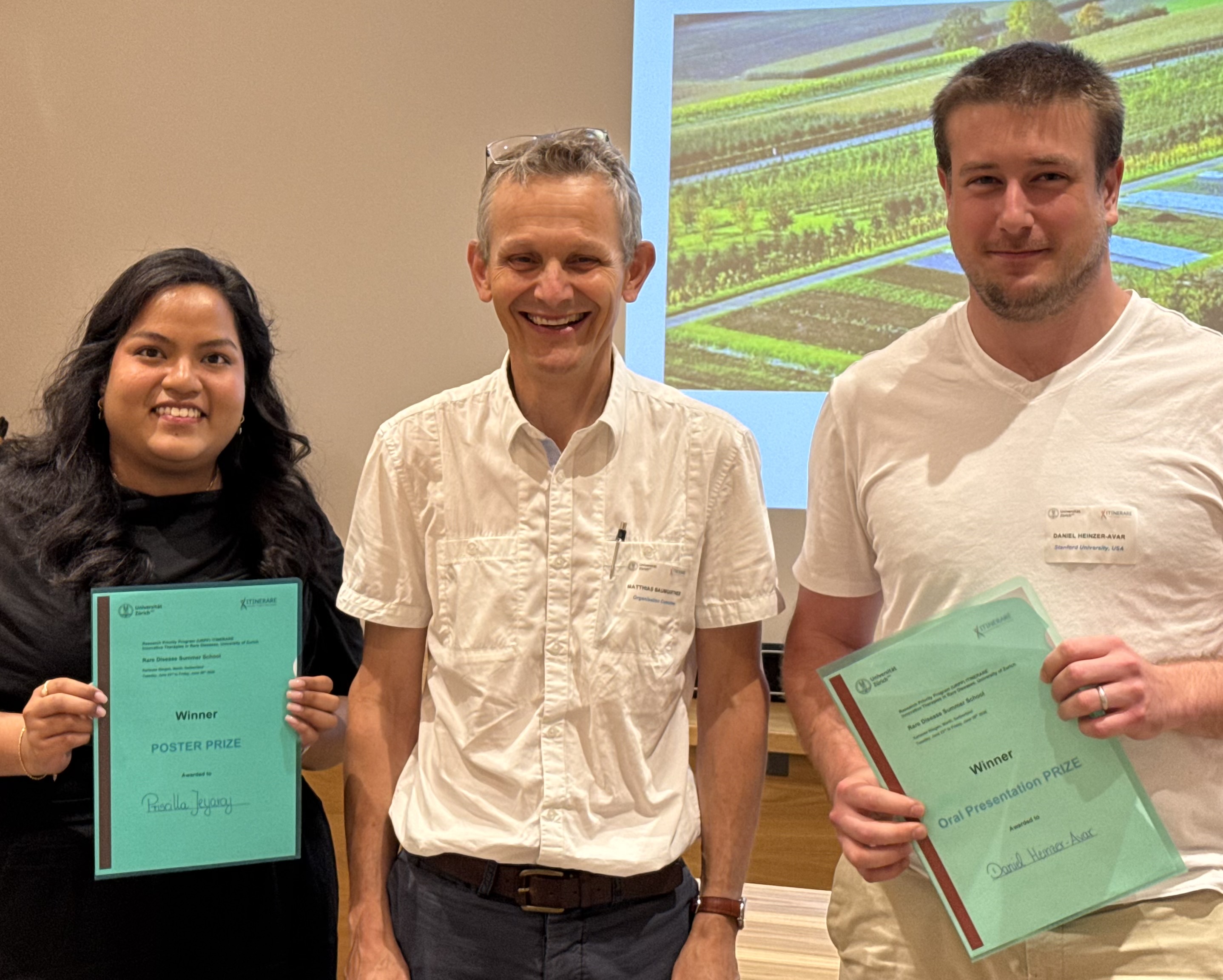
In addition to lectures and interactive workshops, the Summer School provides a platform for short presentations and poster sessions on participants' current research projects.
This year’s winners are:
Priscilla Jeyaraj from the Centre for Public Health, Queen's University Belfast (Poster Prize) and Daniel Heinzer-Avar from the Stanford University (Presentation Prize).